Smartphone
...................................................................................................................................................................................
A smartphone is a mobile phone built on a mobile computing platform, with more advanced computing ability and connectivity than a feature phone. The first smartphones were devices that mainly combined the functions of a personal digital assistant (PDA) and a mobile phone or camera phone. Today's models also serve to combine the functions of portable media players, low-end compact digital cameras, pocket video cameras, and GPS navigation units. Modern smartphones typically also include high-resolution touchscreens, web browsers that can access and properly display standard web pages rather than just mobile-optimized sites, and high-speed data access via Wi-Fi and mobile broadband.
The most common mobile operating systems (OS) used by modern smartphones include Apple's iOS, Google's Android, Microsoft's Windows Phone, Nokia's Symbian, RIM's BlackBerry OS, and embedded Linux distributions such as Maemo and MeeGo. Such operating systems can be installed on many different phone models, and typically each device can receive multiple OS software updates over its lifetime.
The distinction between smartphones and feature phones can be vague and there is no official definition for what constitutes the difference between them. One of the most significant differences is that the advanced application programming interfaces (APIs) on smartphones for running third-party applications can allow those applications to have better integration with the phone's OS and hardware than is typical with feature phones. In comparison, feature phones more commonly run on proprietary firmware, with third-party software support through platforms such as Java ME or BREW. An additional complication in distinguishing between smartphones and feature phones is that over time the capabilities of new models of feature phones can increase to exceed those of phones that had been promoted as smartphones in the past.
Source:Wikipedia, the free encyclopedia
History
Early years


The Nokia Communicator line was the first of Nokia's smartphones starting with the Nokia 9000, released in 1996. This distinctive palmtop computer style smartphone was the result of a collaborative effort of an early successful and costly personal digital assistant (PDA) by Hewlett-Packard combined with Nokia's best-selling phone around that time, and early prototype models had the two devices fixed via a hinge. The Communicators are characterized by a clamshell design, with a feature phone display, keyboard and user interface on top of the phone, and a physical QWERTY keyboard, high-resolution display of at least 640×200 pixels and PDA user interface under the flip-top. The software was based on the GEOS V3.0 operating system, featuring email communication and text-based web browsing. In 1998, it was followed by Nokia 9110, and in 2000 by Nokia 9110i, with improved web browsing capability.
In 1997 the term 'smartphone' was used for the first time when Ericsson unveiled the concept phone GS88,[ the first device labelled as 'smartphone'.
Symbian

Also in 2000, the Nokia 9210 communicator was introduced, which was the first color screen model from the Nokia Communicator line. It was a true smartphone with an open operating system, the Symbian OS. It was followed by the 9500 Communicator, which also was Nokia's first cameraphone and first Wi-Fi phone. The 9300 Communicator was smaller, and the latest E90 Communicator includes GPS. The Nokia Communicator model is remarkable for also having been the most costly phone model sold by a major brand for almost the full life of the model series, costing easily 20% and sometimes 40% more than the next most expensive smartphone by any major producer.
In 2007 Nokia launched the Nokia N95 which integrated a wide range of multimedia features into a consumer-oriented smartphone: GPS, a 5 megapixel camera with autofocus and LED flash, 3G and Wi-Fi connectivity and TV-out. In the next few years these features would become standard on high-end smartphones. The Nokia 6110 Navigator is a Symbian based dedicated GPS phone introduced in June 2007.
February 2009 Samsung launched the i8910hd with well working touchscreen under Symbian, 8 megapixel camera with built-in photoshop-app, HD-video and full internet on it's big size screen.
In 2010 Nokia released the Nokia N8 smartphone with a stylus-free capacitive touchscreen, the first device to use the new Symbian^3 OS.It featured a 12 megapixel camera with Xenon flash able to record HD video in 720p, described by Mobile Burn as the best camera in a phone,and satellite navigation that Mobile Choice described as the best on any phone. It also featured a front-facing VGA camera for videoconferencing.
Symbian was the number one smartphone platform by market share from 1996 until 2011 when it dropped to second place behind Google's Android OS. In February 2011, Nokia announced that it would replace Symbian with Windows Phone as the operating system on all of its future smartphones. This transition was completed in October 2011, when Nokia announced its first line of Windows Phone 7.5 smartphones, Lumia 710 and 800.
Palm, Windows, and BlackBerry
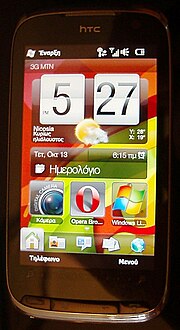
In early 2001, Palm, Inc. introduced the Kyocera 6035, the first smartphone to be deployed in widespread use in the United States. This device combined the features of a personal digital assistant (PDA) with a wireless phone that operated on the Verizon Wireless network. For example, a user could select a name from the PDA contact list, and the device would dial that contact's phone number. The device also supported limited web browsing. The device received a very positive reception from technology publications, but the product line never became widespread outside North America.
In 2001 Microsoft announced its Windows CE Pocket PC OS would be offered as "Microsoft Windows Powered Smartphone 2002."Microsoft originally defined its Windows Smartphone products as lacking a touchscreen and offering a lower screen resolution compared to its sibling Pocket PC devices.
In early 2002 Handspring released the Palm OS Treo smartphone, utilizing a full keyboard that combined wireless web browsing, email, calendar, and contact organizer with mobile third-party applications that could be downloaded or synced with a computer.
In 2002 RIM released their first BlackBerry devices with integrated phone functionality and shifted the positioning of their products from 2-way pagers to email-capable mobile phones. The BlackBerry line evolved into the first smartphone optimized for wireless email use and had achieved a total customer base of about 32 million subscribers by December 2009.
iPhone

In July 2008, Apple introduced its second generation iPhone with a lower list price starting at $199 and 3G support. Released with it, Apple also created the App Store, adding the capability for any iPhone or iPod Touch to officially execute additional native applications (both free and paid) installed directly over a Wi-Fi or cellular network, without the more typical process at the time of requiring a PC for installation. Applications could additionally be browsed through and downloaded directly via the iTunes software client on Macintosh and Windows PCs, rather than by searching through multiple sites across the Internet. Featuring over 500 applications at launch,Apple's App Store was immediately very popular, quickly growing to become a huge success.
In June 2010, Apple introduced iOS 4, which included APIs to allow third-party applications to multitask,and the iPhone 4, which included a 960×640 pixel display with a pixel density of 326 pixels per inch (ppi), a 5 megapixel camera with LED flash capable of recording HD video in 720p at 30 frames per second, a front-facing VGA camera for videoconferencing, an 800 MHz processor, and other improvements. In early 2011 the iPhone 4 became available through Verizon Wireless, ending AT&T's exclusivity of the handset in the U.S., and allowing the handset's 3G connection to be used as a wireless Wi-Fi hotspot for the first time, to up to 5 other devices.Software updates subsequently added this capability to other iPhones running iOS 4.
The iPhone 4S was announced on October 4, 2011, improving upon the iPhone 4 with a dual core A5 processor, an 8 megapixel camera capable of recording 1080p video at 30 frames per second, World phone capability allowing it to work on both GSM & CDMA networks, and the Siri automated voice assistant. On October 10, Apple announced that over one million iPhone 4Ss had been pre-ordered within the first 24 hours of it being on sale, beating the 600,000 device record set by the iPhone 4,despite the iPhone 4S failing to impress some critics at the announcement due to their expectations of an "iPhone 5" with rumored drastic changes compared to the iPhone 4 such as a new case design and larger screen. Along with the iPhone 4S Apple also released iOS 5 and iCloud, untethering iOS devices from Macintosh or Windows PCs for device activation, backup, and synchronization, along with additional new and improved features.
There are about 35 percent of Americans that have some sort of smartphone. This shows that the market is spreading fast and there are also more capabilities for smartphones because of this spread.
Smartphones are also mainly valuable based on the operating system. For example, the iPhone runs on the iOS and other devices run different operating systems which makes the functionality of these systems different.
Android

In January 2010, Google launched the Nexus One smartphone using its Android OS. Although Android has multi-touch abilities, Google initially removed that feature from the Nexus One, but it was added through a firmware update on February 2, 2010.
Concerning the Xperia Play smartphone, an analyst at CCS Insight said in March 2011 that "Console wars are moving to the mobile platform".In the same month, the HTC EVO 3D was announced by HTC Corporation, which can produce 3D effects with no need for special glasses (autostereoscopy).The HTC EVO 3D was officially released on June 24, 2011.
Bada
The Bada operating system for smartphones was announced by Samsung on 10 November 2009. The first Bada-based phone was the Samsung Wave S8500, released on June 1, 2010, which sold one million handsets in its first 4 weeks on the market.Samsung shipped 3.5 million phones running Bada in Q1 of 2011. This rose to 4.5 million phones in Q2 of 2011.
Patent licensing and litigation
Main article: Smartphone patent licensing and litigation
See also: Apple Inc. litigation
Recently the number of lawsuits, trade complaints, and countersuits and complaints based on patents and designs in the markets for smartphones, and devices based on smartphone OSes such as Android and iOS, has been increasingScreen
Screens on smartphones vary largely in both display size and display resolution. The most common screen sizes range from 2 inches to over 4 inches (measured diagonally). Some 5 inch screen devices exist that run on mobile OSes and have the ability to make phone calls, such as the discontinued Dell Streak and the current Samsung Galaxy Note. Ergonomics arguments have been made that increasing screen sizes start to negatively impact usability.[citation needed]Common resolutions for smartphone screens vary from 240×320 to 720×1280, with many flagship Android phones at 480×800 or 540×960, the iPhone 4/4S at 640×960 and Galaxy Nexus and HTC Rezound at 720×1280.
Application stores
Main article: List of digital distribution platforms for mobile devices
The introduction of Apple's App Store for the iPhone and iPod Touch in July 2008 popularized manufacturer-hosted online distribution for third-party applications focused on a single platform. Before this, smartphone application distribution was largely dependent on third-party sources providing applications for multiple platforms, such as GetJar, Handango, Handmark, PocketGear, and others.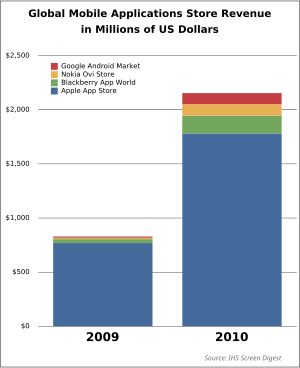
Following the success of Apple's App Store other smartphone manufacturers quickly launched application stores of their own. Google launched the Android Market in October 2008. MiKandi launched the first adult app market for smartphones in 2009. RIM launched its app store, BlackBerry App World, in April 2009. Nokia launched its Ovi Store in May 2009. Palm launched its Palm App Catalog for webOS in June 2009. Microsoft launched an application store for Windows Mobile called Windows Marketplace for Mobile in October 2009, and then a separate Windows Phone Marketplace for Windows Phone in October 2010. Samsung launched Samsung Apps for its Bada based phones in June 2010. Amazon launched its Amazon Appstore for the Google Android operating system in March 2011.
| Store | 2009 (millions U.S.) | 2012 (millions U.S.) |
|---|---|---|
| Apple App Store | $769 | $5782 |
| Blackberry App World | $36 | $165 |
| Nokia Ovi Store | $13 | $105 |
| Google Play | $11 | $102 |
| Total | $828 | $6154 |
Malicious software attacks
Main articles: Mobile security, Malware, and Mobile virus
As smartphone adoption goes up they have increasingly become subject to attacks by malicious software (malware).Frequently this malware is distributed through application stores that have minimal or no review process for their content.In some cases malware has been hidden in pirated versions of legitimate apps, which are then distributed through 3rd party app stores. Malware risk also comes from what's known as an "update attack," where a legitimate application is later changed to include a malware component, which users then install when they are notified that the app has been updated. Additionally, the ability to acquire software directly from links on the web results in a distribution vector called "malvertizing," where users are directed to click on links, such as on ads that look legitimate, which then open in the device's web browser and cause malware to be downloaded and installed automatically.
Typical smartphone malware leverages platform vulnerabilities that allow it to gain root access on the device in the background. Using this access the malware installs additional software to target communications, location, or other personal identifying information. A common form of malware on mobile phones is the SMS trojan, which sends premium SMS messages, possibly while unknowingly running in the background of a legitimate application. These premium SMS messages run up charges on the owner's phone bill which cannot be recovered.
In August 2010, Kaspersky Lab reported detection of the first malicious program for smartphones running on Google's Android operating system, named Trojan-SMS.AndroidOS.FakePlayer.a, an SMS trojan which had already infected a number of devices using that OS.Over the spring of 2011 Android malware increased 76%, according to McAfee.A report from Juniper Global Threat Center notes that malware on the Android platform increased 400% from 2009 to the summer of 2010, and then saw a 472% increase between July and November 2011.The Juniper report indicates that 55% of Android malware acts as spyware, and 44% are SMS trojans.
While there have been and continue to be potential security flaws in iOS, as of at least August 2011 there were no known malware or spyware apps in Apple's App Store, according to security firm Lookout. There are however commercial spyware applications available, outside the App Store, for jailbroken iOS devices. In June 2011 Symantec's 23-page report "A Window Into Mobile Device Security" characterized (non-jailbroken) devices running iOS as having "full protection" against malware attacks.
Symbian and older versions Windows Mobile have had to contend with a degree of malware in the past, but as legacy systems it is believed that the people who previously targeted them have shifted their focus to Android. There were also a few Palm OS viruses.
The only mobile platform other than Apple's iOS without reports of malware so far is HP's (formerly Palm's) webOS, but this may be explained by its relatively low adoption rate.
The best way to reduce a device's vulnerability to malware attacks is to install the most recent versions of operating systems which include security patches. This can be complicated by long delays in software updates for many devices which have had their software modified with custom "skins," services, or promotional on-deck apps by their manufacturer or mobile carrier. In some cases a device may no longer be receiving updates from its manufacturer or carrier, leaving it vulnerable to exploits that have been patched in an OS version that's more recent than the device's last supported one.
For several years, demand for advanced mobile devices boasting powerful processors and graphics processing units, abundant storage (flash memory) for applications and media files, high-resolution screens with multi-touch capability, and open operating systems has outpaced the rest of the mobile phone market.
According to an early 2010 study by ComScore, over 45.5 million people in the United States owned smartphones out of 234 million total subscribers. Despite the large increase in smartphone sales in the last few years, smartphone shipments only made up 20% of total handset shipments as of the first half of 2010.
According to Gartner in their report dated November 2010, total smartphone sales doubled in one year and now smartphones represent 19.3 percent of total mobile phone sales.Smartphone sales increased in 2010 by 72.1 percent from the prior year, whereas sales for all mobile phones only increased by 32%.
According to an Olswang report in early 2011, the rate of smartphone adoption is accelerating: as of March 2011 22% of UK consumers had a smartphone, with this percentage rising to 31% amongst 24- to 35-year-olds.
In March 2011, Berg Insight reported data that showed global smartphone shipments increased 74% from 2009 to 2010.
A survey of mobile users in the United States by Nielsen in Q3, 2011 reports that smartphone ownership has reached 43% of all U.S. mobile subscribers, with the vast majority of users under the age of 44 owning one. In the 25-34 age range smartphone ownership is reported to be at 62%. NPD Group reports that the share of handset sales that were smartphones in Q3, 2011 reached 59% for consumers 18 and over in the U.S.In profit share worldwide smartphones now far exceed the share of non-smartphones. According to a November 2011 research note from Canaccord Genuity, Apple Inc. holds 52% of the total mobile industry's operating profits, while only holding 4.2% of the global handset market. HTC and RIM similarly only make smartphones and their worldwide profit shares are at 9% and 7%, respectively. Samsung, in second place after Apple at 29%, makes both smartphones and feature phones and doesn't report a breakdown separating their profits between the two kinds of devices, but it can be intuited that a significant portion of that profit comes from their flagship smartphone devices.
Up to the end of November 2011, camera-equipped smartphones took 27 percent of photos, a significant increase from 17 percent last year. For many people smartphones have replaced Point-and-shoot cameras.
Main article: Mobile operating system
2010 saw the rapid rise of the Google Android operating system from 4 percent of new deployments in 2009 to 33 percent at the beginning of 2011 making it share the top position with the since long dominating Symbian OS. The smaller rivals include US popular Blackberry OS, iOS, Samsung's recently introduced Bada, HP's heir of Palm webOS and the Microsoft Windows Phone OS which is now supported by Nokia.Historical sales figures
Figures in millions.| Year | Android (Google) | Blackberry (RIM) | IPhone (Apple) | Linux | Palm/WebOS (Palm/HP) | Symbian (Nokia) | Windows Mobile/Phone (Microsoft) | Other |
|---|---|---|---|---|---|---|---|---|
| 2007 | 11.77 | 3.3 | 11.76 | 1.76 | 77.68 | 14.7 | ||
| 2008 | 23.15 | 11.42 | 11.26 | 2.51 | 72.93 | 16.5 | ||
| 2009 | 6.8 | 34.35 | 24.89 | 8.13 | 1.19 | 80.88 | 15.03 | |
| 2010 | 67.22 | 47.45 | 46.6 | 111.58 | 12.38 |
In a worldwide study of 2,300 workers at 1,100 businesses by iPass it was reported that Apple's iPhones have displaced RIM's BlackBerry devices in enterprise adoption in 2011. The share for iPhones increased to 45% from 31.1% in 2010, while the Blackberry share dropped to 32.2% from 34.5% in the previous year. Android phones also increased in share, to 21.3% from 11.3% in 2010, exceeding Symbian for the first time, which dropped to 7.4% from 12.4%. Windows Mobile and all other smartphone OSes also dropped in 2011 compared to 2010.
Customer loyalty by operating system
According to a survey of more than 6,000 smartphone users through 2010 by mobile analytics firm Zokem, the top five loyalty scores for smartphone platforms are the iPhone at 73%, followed by Google's Android at 40%, Samsung's Bada at 33%, RIM's BlackBerry at 30%, and Symbian S60 at 23%. Windows Mobile and Palm follow at 10% each. Customer loyalty gauges the likelihood that the user of a smartphone platform whose contract has expired or who has broken or lost their phone will repurchase another one that uses that same platform.Size of Market
According to a 2012 survey, half of the U.S. mobile consumers own smartphones. Nielsen, figures, as of February, say 49.7% of U.S. mobile owners have smartphones. Nielsen also notes, that at current rate, smartphones could account for 70% of all U.S. mobile devices by next year. | This article is outdated. Please update this article to reflect recent events or newly available information. Please see the talk page for more information. (March 2012) |
Market share among smartphone manufacturers does not resemble smartphone OS market share numbers due to the differences between the two major smartphone OS sales models: single manufacturer and licensed. Apple's iPhone, Nokia's Symbian, and RIM's BlackBerry smartphones are currently only available from single manufacturers. Google's Android OS and Microsoft's mobile OSes are platforms that are licensed and used by a variety of manufacturers. As a result, manufacturers of smartphones using licensed OSes all split the total market share of that OS between them, while the total share for a single-manufacturer OS is held by that manufacturer alone.
Note that Nokia's Symbian OS was previously available from several manufacturers under a licensed model, then later predominantly only by Nokia itself more like a single manufacturer model.
Samsung smartphones use a diverse portfolio of operating systems, including their own Bada operating system along with Android and Windows Mobile.Apple surpassed Nokia worldwide by revenue and profit for the first time in Q2 2011 (though not in market share), with Apple's profit share of the total worldwide smartphone market increasing to 66.3% while Nokia reported a loss.
Between Q2 2010 and Q2 2011 Nokia's worldwide Symbian smartphone sales dropped significantly from 38.1 percent to 15.2 percent, while Samsung smartphone sales increased significantly worldwide from 5% to 17.5%.As of Q1 2011, Nokia had already announced plans to switch to Windows Phone.
Nokia still remains the number one company in the worldwide mobile phone market with sales for Q2 2011 of 88.5 million when including feature phone platforms such as S40, compared with 16.7 million smartphones running Symbian.
According to Nielsen in July 2011, in the United States Apple is the top smartphone manufacturer at 28% of the market, with RIM at 20%. Google Android has 39% of the U.S. market as a whole, but this is split between HTC at 14%, Motorola at 11%, Samsung at 8%, and other remaining manufacturers at 6%. HTC's total share of the U.S. smartphone market actually ties RIM at 20%, since sales of their smartphones running Microsoft's mobile operating systems account for 6% of the total market. Samsung similarly gains 2% of overall U.S. market share due to their sales of Microsoft OS-based smartphones. In contrast to the worldwide market, Nokia's share of U.S. smartphone sales is very small, at only 2%. Nielsen's Q3, 2011 survey of mobile users maintains Apple as the top U.S. smartphone maker with a continued 28% of the market, with RIM dropping from 20% to 18%. While Google Android increased in total operating system share from 39% to 43% of the U.S. market, it remains fragmented amongst many different manufacturers. Over the same quarter Microsoft managed a modest gain from 6% to 7% total U.S. smartphone OS share.
Checks with U.S. carriers by technology analyst firm Canaccord Genuity in April and August 2011 have found that Apple's iPhone 4 has consistently been the top selling device at AT&T and Verizon. In addition, the second most popular spot at AT&T has been maintained by the iPhone 3GS, which was originally released in 2009 (and has never been sold on Verizon). In August 2011 the most popular smartphones on Sprint and T-Mobile in the U.S. were the HTC EVO 3D 4G and HTC Sensation, respectively. The other second most popular smartphones were the Samsung Charge 4G on Verizon, the Motorola Photon 4G on Sprint, and the HTC myTouch 4G Slide on T-Mobile. NPD Group reported that in Q3, 2011 the overall top 5 smartphones by sales across all carriers in the U.S. were, in order: the iPhone 4, iPhone 3GS, HTC EVO 4G, Motorola Droid 3, and Samsung Intensity II.
Currently the vast majority of smartphones are manufactured in China, Taiwan and Mexico, for companies based in the U.S. (Apple, HP, Motorola), South Korea (LG, Samsung), Canada (RIM), Finland (Nokia), Taiwan (HTC) and the U.K. (Sony Ericsson).
In Q3 2011, Samsung became the world's number one smartphone vendor, selling 24 million smartphones. Nokia's Symbian platform remained in second place with 19.5 million Symbian smartphones, and Apple fell to third place, with 17 million phones. Android had 52.5% of the market, with 60.5 million Android phones being sold. In the US, HTC became the largest smartphone vendor.
Customer satisfaction by manufacturer
According to global marketing information services firm J.D. Power and Associates smartphones from Apple Inc. have been consistently ranking highest in customer satisfaction, with a late 2011 score of 838 out of 1000. Based on the responses to their most recent survey of 6,898 smartphone users, Apple was followed in ranking by HTC (801), Samsung (777), Motorola (775), RIM (762), LG (760), Palm (733), and Nokia (721).Open-source development
The open-source culture has penetrated the smartphone market in several ways. There have been attempts to create open source hardware and software for smartphones.
In February 2010 Nokia made Symbian open source. Thus, most commercial smartphones were based on open-source operating systems. These include those based on Linux, such as Google's Android, Nokia's Maemo, Hewlett-Packard's webOS, and those based on BSD, such as the Darwin-based Apple iOS. Maemo was later merged with Intel's project Moblin to form MeeGo.
Popular services
Location-based check-in services
According to a ComScore report released on May 12, 2011, nearly one in five smartphone users are tapping into check-in services like Foursquare and Gowalla. A total of 16.7 million mobile-phone subscribers used location-based services on their phones in March 2011.
Second screen
Some smartphones allow watching television using a second screen for media multitasking.
Definition:
A smartphone is a device that lets you make telephone calls, but also adds features that you might find on a personal digital assistant or a computer. A smartphone also offers the ability to send and receive e-mail and edit Office documents, for example.
While there is no standard definition of the term "smartphone" across the industry, there are a few features that you'll find on every smartphone. Here's a list:
Printing From Smartphone – Ever wondered how you can print that special picture you took using your smartphone? Or maybe you desire some guidance on the best way to print images you have on your smartphone. Well, I’m discussing below some details about Hewlett Packard’s software called iPrint Photo designed to enable you to print via smartphones such as iPhone, Windows Mobile, Htc and Android. Many tool can also be used for printing from a great iPad or ipod itouch.
Having an Apple mobile phone, you can get this software-tool by means of Apps store which you could have it automatically set up. Another way is via your personal machine and iTunes. Soon after installation on your pc, then you’re able to connect your cell phone to your PC and activate Synchronization (Sync).
Using a Windows Mobile version 6.5 smart phone go to Windows Marketplace for Mobile and have the idea installed. With a Htc phone, you can visit Ovi store and acquire the free iPrint Photograph App. For an Android mobile phone smartphone you can trigger Android Market and download the software there.
Operating System: A smartphone will be based on an operating system that allows it to run productivity applications, such as the BlackBerry OS, the Palm OS, or Windows Mobile.
Software: A smartphone will offer more than just an address book. It may allow you to create and edit Microsoft Office documents or manage your finances.
Web Access: A smartphones offer some sort of access to the Internet. You can use your smartphone to browse your favorite Web sites.
QWERTY Keyboard: A smartphone includes a QWERTY keyboard, so the keys are laid out in the same manner they would be on your computer keyboard.
Messaging: All cell phones can send and receive text messages, but what sets a smartphone apart is its ability to send and receive e-mail. Some smartphones can support multiple e-mail accounts. Others include access to the popular instant messaging services, like AOL's AIM and Yahoo! Messenger.
Alternate Spellings: smart phone
And not all smartphone operating systems are created equal. Whether you're considering an iPhone, an Android phone, a BlackBerry, or a Windows Phone, all of these devices have pros and cons.
Printing From Smartphone
Depending on what smartphone you have, it is possible to print photos that are stored in one of the graphic formats with the document dot extension.bmp,.png,.jpeg and.tiff. If you want to rotate or resize a photo you can do that by activating the rotate/crop feature while touching the photograph in the Print Examine screen of the software program.
Printing From Smartphone
Depending on what smartphone you have, it is possible to print photos that are stored in one of the graphic formats with the document dot extension.bmp,.png,.jpeg and.tiff. If you want to rotate or resize a photo you can do that by activating the rotate/crop feature while touching the photograph in the Print Examine screen of the software program.Then, touch most of the photo using 2 fingers. You can then rotate or plants the image. When you’re content with the result and want to quit editing, touch your photo once more then, touch Print. It’s also possible to resize your image in the Print Options menu which you can find by touching your Printer icon inside Print Preview monitor.

Printing From Smartphone
A lot of HP laser printers can work with the mobile print software, from certain phones, to name a few: Business Inkjet One thousand and 1200, Deskjets 5145, 5150 string, 9800 series, and more. Officejet 6110 sequence, Photosmart Compact Photo Ink jet printers. Printing from other phones, with printers such as Business Inkjet A thousand and 1200, Shade Inkjet cp1700 series, Deskjet Portable Printers 450 string, 6988 series, Officejet 4500 sequence, H470 Mobile Printer series, various Photosmart printers and also way, way more.
Printing From Smartphone
When you have several photos as well as you’d like to print them in one go, then it depends on the smartphone you’ve got if that is possible. A number of phones allow synchronised printing of two or more photos. And with additional phones such as Android smartphones, you can printing only one photo at the same time. You can print a lot more photos at once when you have a Nokia or even Windows Mobile cell phone.Mind that printing stops when you response a SMS communication or phone call. After you finish messaging or perhaps calling, you need to re-initiate printed process. You can prevent that by not really responding a message or perhaps call at once. Then the printing will not be cut off.
Smartphone News 2011 – HTC Sensation vs. Samsung Galaxy S 2
With so many popular smartphones it’s getting tougher as well as tougher to pick the proper phone, so we give you a comparison between two smartphones which can be successfully representing the class of smartphones: HTC Sensation and Samsung Galaxy S 2.Smartphone News 2011 - The Battle of HTC vs Samsung
HTC Sensation vs. Samsung Galaxy S 2 will launched in the same period, the first quarter of This year.HTC Sensation weighs 148 grams, having the sizes 126.1 x 65.4 x 11.3 mm plus a 4.3-inch S-LCD capacitive touch screen. Galaxy S II weighs 116 grams, has 125.3 x 66.1 x 8.5 mm and comes with a 4.3-inch super AMOLED touchscreen technology, which means the last one is slightly thinner and also lighter than HTC Sensation.
Galaxy S 2 has an internal memory of 16 GB and 32 GB using microSD card slot up to 32GB, one of 8GB being included. Sensation has a 1GB internal memory, microSD card slot up to 32GB and one of 8GB included.
Both phones are equipped with two cameras, one of 8 mp, going to 3265×2448 pixels, with auto-focus and LED flash, the Sensation having a dual LED flash.
The cameras offer the possibility of geo tagging, focus effect, image stabilizer and face detection. Furthermore, Sensation allows instantaneous image capture.
Equally phones can function video recording in 1080p with 30 fps and on HTC we’ve got to point, in addition, stereo recording. On the other hand, the next camera of Samsung Galaxy S 2, for video calls, can be slightly better, getting larger to 2 megapixels. But this detail does not matter too much, but there will be a day when is bound to matter: what’s good in making video calls if you can’t make them in terms of good quality?
The operating system regarding both smartphones will be Android 2.3 Gingerbread that are running on a 1.2-GHz dual core.
We don’t even have to refer to the radio, EDGE, 3G (there’s a HTC version of 4G), of course, found on both phones. Each come in one colour, black.
Galaxy S II’s battery last up to 18 hours and 20 minutes in 2G (8 hours and 40 min’s in 3G), while Sensation’s only last as much as 8 hours as well as 20 minutes in 2G and 6 hours and 40 minutes in 3G.
Get more Smartphone News 2011.
Iphone 5 Release Date Rumors
On April 27th, 2012 by maureen | No Comments | Posted in Iphone
Iphone 5 release date, Following the rumor nevertheless Apple will conduct a press event for the 7th of next month, the iPhone 5 is expected to be immediately visible. The handset is rumored to be removed during the time of Halloween.
In a article at 9to5 Mac, sources advise that Apple will almost certainly launch the iphone 5 release date in a choice October 7th or perhaps a week later exactly for the October 14th. The creation of the best anticipated device is arranged to become running nicely so Apple is a bit more inclined to your earlier date. Also, the corporation can be think about the opening for that device’s pre-orders.

The organization will reportedly take pre-orders of your iPhone 5 starting around the late September, and they are considering a better between the 29th and 30th. The sources declared that the future time could be more likely.

On top of that, Apple is additionally rumored to become release its two new handsets that might be viewed as an all new flagship model and also a inexpensive alternative for consumers on budget. The handset which is rumored to return having a 4G LTE compatibility is regarded any phone.
These types of speculations can be confusing, but, Apple has promised to support a “major product transition” in September. However the company haven’t to be sure of this, the iphone 5 release date rumors regarding the IPhone 5 Smartphone is most probably true. Well, any idea what?
In a article at 9to5 Mac, sources advise that Apple will almost certainly launch the iphone 5 release date in a choice October 7th or perhaps a week later exactly for the October 14th. The creation of the best anticipated device is arranged to become running nicely so Apple is a bit more inclined to your earlier date. Also, the corporation can be think about the opening for that device’s pre-orders.
Iphone 5 release date
The organization will reportedly take pre-orders of your iPhone 5 starting around the late September, and they are considering a better between the 29th and 30th. The sources declared that the future time could be more likely.
iphone 5 release date
On top of that, Apple is additionally rumored to become release its two new handsets that might be viewed as an all new flagship model and also a inexpensive alternative for consumers on budget. The handset which is rumored to return having a 4G LTE compatibility is regarded any phone.
These types of speculations can be confusing, but, Apple has promised to support a “major product transition” in September. However the company haven’t to be sure of this, the iphone 5 release date rumors regarding the IPhone 5 Smartphone is most probably true. Well, any idea what?
Samsung Wave 525 Mobile – The Next wave
On April 26th, 2012 by maureen | No Comments | Posted in Samsung
Fun & Useful apps in Samsung Wave 525 Mobile
With Samsung Wave 525 Mobile abundant supply of next-generation apps you can enjoy an expansive mobile experience customized to suit your particular lifestyle. Supported by the service-oriented, bada platform, Wave lets developers continually create new apps—games, e-books, news, utility and more—to keep your mobile experience fresh and continually expanding. It offers more than 80 freemium* applications and includes convenient support services like in-app purchase support, background D/L and update notifications. * freemium = free + premiumSocial Hub : Anytime, Anywhere – Share Life Experiences
Phonebook seamlessly integrates all of your SNS, IM, e-mail and calendar accounts, so you no longer need to spend time checking separate sites.
- Features are clearly organized into four categories : Info, History, Activities and Media
- Sync with various web calendars and send event invitations to friends instantly
Social Mapping
Samsung Wave 525 Mobile comes complete with an innovate social mapping tool so you can more easily store your location of pictures you took. With geo-tagging, you can stamp all your photos with metadata so your images come to life.
Rapid Connectivity
Samsung Wave 525 Mobile delivers the fastest wireless LAN available, so you never have to wait to enjoy your favorite games, video, and apps. Wave’s lightning quick 802.11b/g/n connectivity provides ample support for Samsung apps service on 2.5 G, letting you enjoy next generation apps not supported by most other mobiles. And Samsung Wave 525 Mobile comes with BT 3.0+EDR and microUSB, so no matter where you are, you’re always connected.
Intuitive TouchWiz UI 3.0
Advanced TouchWiz UI makes your mobile experience more intuitive and easy. Enhanced homescreen can be customized up to 10 screens. Also advanced widgets such as daily briefing and buddies now let you access many information directly.
Samsung Wave 525 Mobile offers a sleek
compact design perfect for those who appreciate a minimalist aesthetic. Slim 11.9 mm body fits comfortably in the palm of your hand and a a wide 3.2” WQVGA display lets you comfortably view games, videos, pictures and more.Smartphone Graphics to Soon Surpass Xbox 360? [VIDEO]
Want your phone's graphics to match those of top gaming systems such as the Xbox 360? Just wait until about 2014 when graphics hardware giant NVIDIA estimates that smartphone graphics might whip those of the popular gaming console.
[More from Mashable: Band to Take Requests via Text During Upcoming Concert]
According to a chart showing yearly graphic performance of console, PC, and mobile devices, it looks like your smartphone could soon host the same type of graphics processing unit (GPU) as the Xbox 360.
Apple's new iPad, with its stunning Retina display, makes games such as Infinity Blade Dungeons look even crisper. But could your smartphone replace your Xbox gaming system? Maybe not yet -- at the moment this is just speculation. Plus it's been six years since Microsoft, Sony, and Nintendo have updated their consoles. It's possible sharper graphics are on everyone's "to-do" list. [More from Mashable: How Green Is Your iPad? [INFOGRAPHIC]]
Would you prefer to play games on your smartphone, console or both, if the graphics were both top-notch? Tell us in the comments.
Today's Smartphone Operating Systems
- Android OS: Geeky But Good
- iOS Gets Multitasking and More
- Palm's Slick webOS
| Stores: |
| Brands: |
Topics elated to smartphone
straight talk
smartphone reviews
smartphone comparison
at&t smartphone
smartphone reviews
smartphone comparison
at&t smartphone
smartphone card
Google smartphone
Verizon wireless smartphone
best buy smartphone
smartphones2010
smartphones2011
smartphones2012
smartphones(Upcoming)
4G GPS Phones
4G Smartphones
Android Smartphones
Best BlackBerry Smartphones
Cheap Smartphones
Google smartphone
Verizon wireless smartphone
best buy smartphone
smartphones2010
smartphones2011
smartphones2012
smartphones(Upcoming)
| new smartphones | iPhone | straight talk |
| best smartphones | PDA | Verizon |
| best smartphones of 2009 | smart telecom | smart |
4G Smartphones
Android Smartphones
Best BlackBerry Smartphones
Cheap Smartphones
Smartphones Directories
What is Smartphone
Structure of Smartphone
Types of Smartphone
Manufacturer Brand of Smartphone
Expensive Smartphones
Cheap Smartphones
Available current Smartphones
Online shops of Smartphones
Internet expert Smartphones
Wi-Fi expert Smartphones
Programming expert SmartphonesApps expert Smartphones
Gaming expert Smartphones
Maps expert Smartphones
Music expert Smartphones
Touch expert Smartphones
Typing expert Smartphones
Camera expert Smartphones
3G expert Smartphones
Blue-tooth expert Smartphones
GPS expert Smartphones
Long-Life Battery facilitated Smartphones
Huge Memory slot Smartphones
